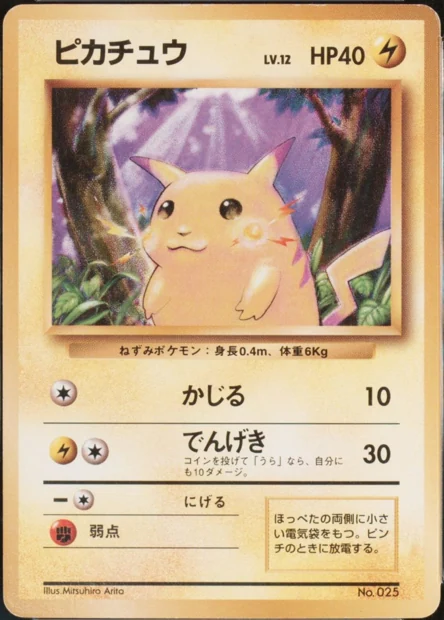
The first research edition of this project covers 1996 through 2000: the first five calendar years of Pokémon. It brings together Japanese and English specimens, print distinctions, distributions, and selected licensed cards.
The website is built to continue beyond those years. Its current coverage is shown on the archive page, and new documented records can extend the timeline without replacing the original edition.
A pictured entry is not always a separate release
Some entries represent a family of print differences. Others record a redistribution, an award, or a production error. A product launch does not establish the date of every specimen associated with it.
Read the date label and variant notes together. Where a printing day or delivery date remains unknown, that uncertainty stays visible.
The marketing sample has its own place
The Ivy marketing specimen sits outside the public-release chronology. Its physical differences belong in the history. A documented advertising appearance does not, by itself, establish public distribution or an earliest printing date.
Inspect the marketing specimen and its source.
Use the images with their qualifications
The archive uses real specimen photographs and scans. Some originals are small. Several reverse variants share a reference image of the front. Personalized awards and licensed-card families also have gaps in image coverage.
Opening a larger image helps with inspection, but it cannot recover detail that was absent from the original photograph. Read any shared-image or missing-scan qualifications beside the specimen.
Keep building the record
This is not a verified census of every licensed object, incidental Pikachu appearance, or one-off printing defect. The scope and known gaps are part of the archive itself.
Each specimen has a permanent page and research links. A new source, a clearer scan, or a correction can make the next edition more useful.