Before the modern One Piece Card Game
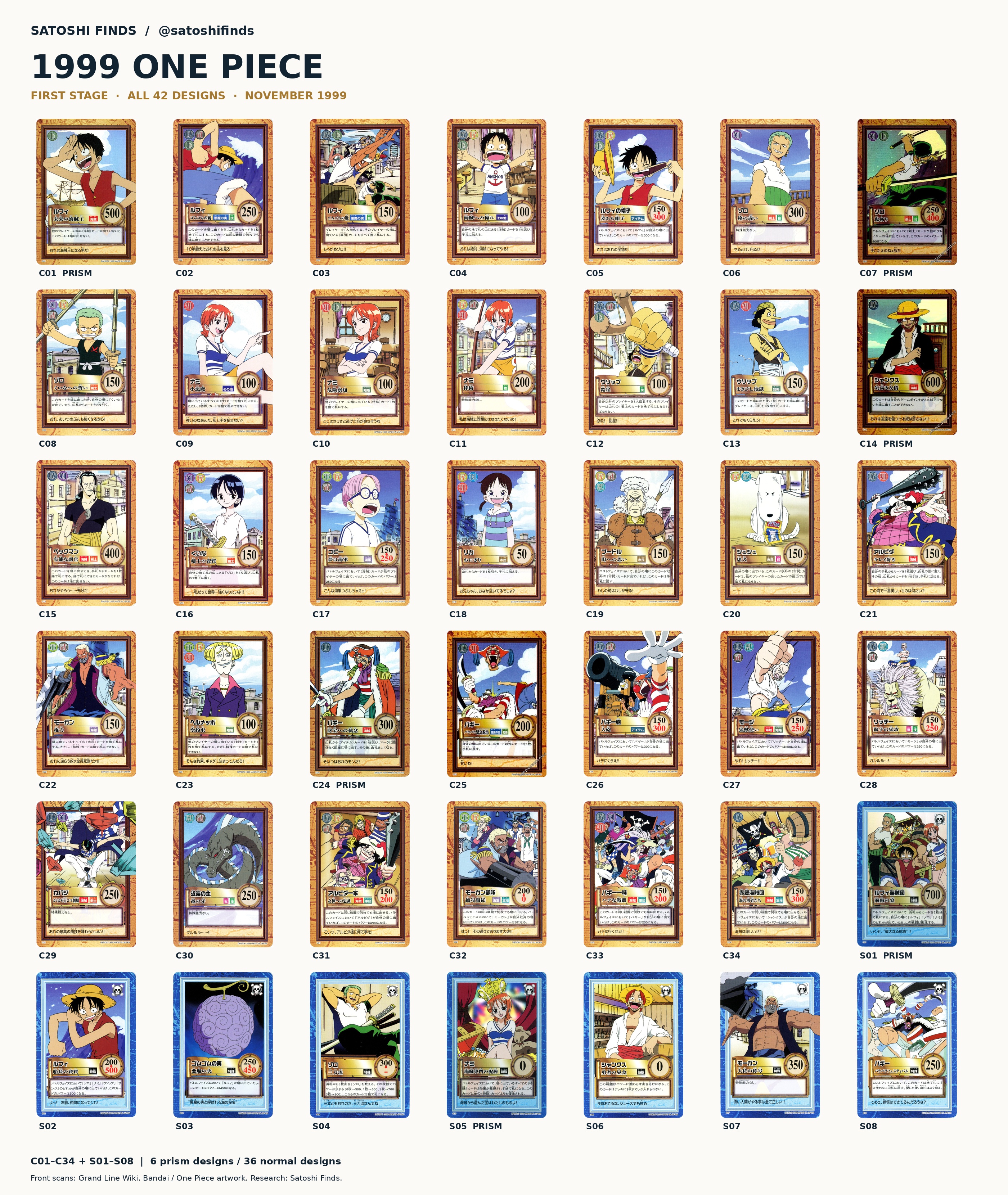
Bandai's One Piece Carddass Hyper Battle began in November 1999. The earliest recovered retail release is First Stage: VERSUS!! Buggy Pirates, a 42-design vending-machine set. The original display advertises four cards for ¥100, with 34 character cards and eight reversal cards. Six of the 42 designs are prism cards.
This archive follows the objects from that launch into the early promotional network: Jump Festa, cinema ticket counters, the Tokyo Toy Show and organized play. It uses actual scans and specimen photographs. Unresolved dates stay unresolved.
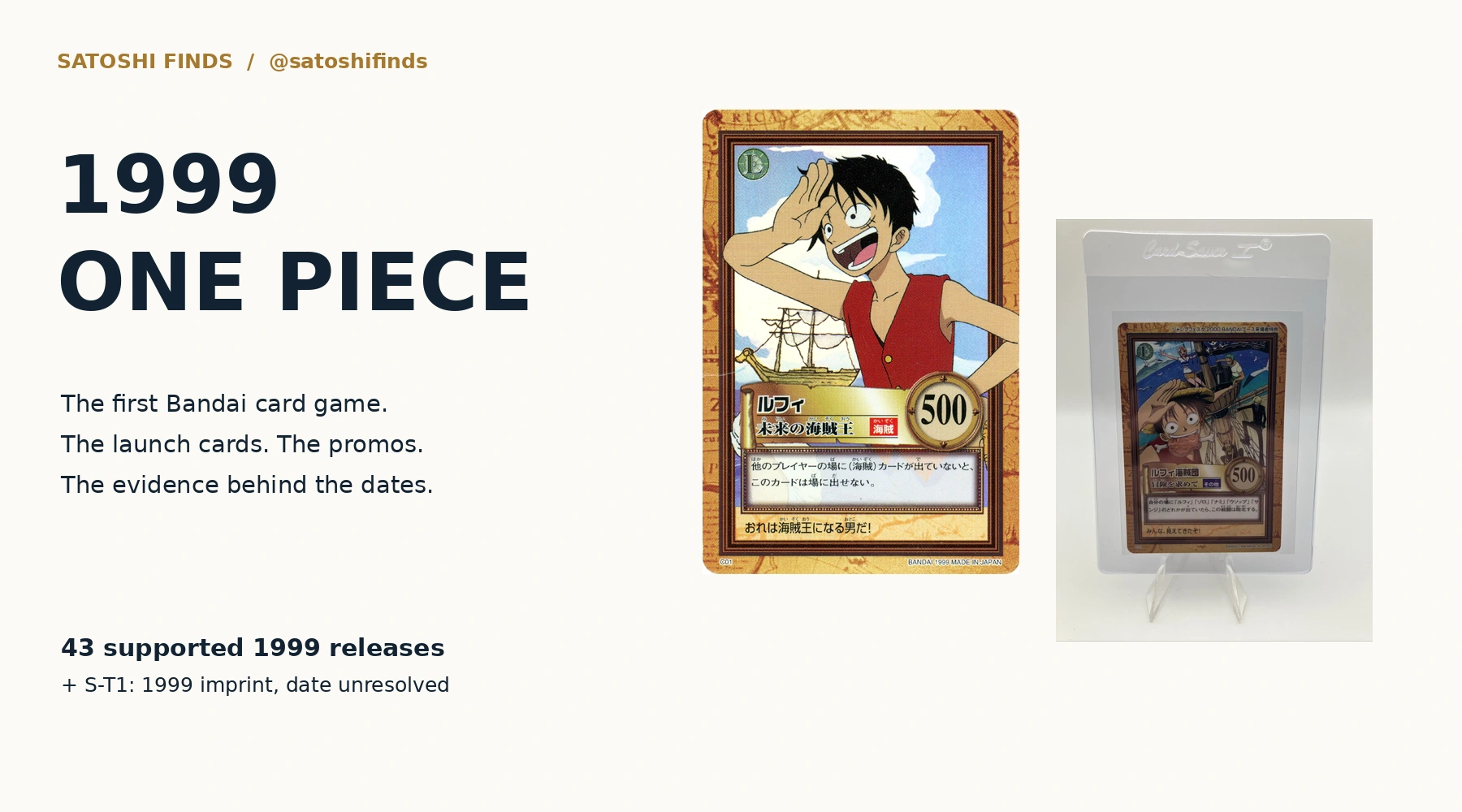
The 1999 census is 43 supported calendar-year releases plus S-T1, a card with a 1999 imprint whose first distribution date has not been established. The catalog below also includes eight later promotional records as comparison dossiers. Its total of 52 card records (51 pictured and one text-only) is not a claim that all 52 were issued in 1999.
Read the complete 63-page book · Download the PDF · Download the 44-entry research register
C-J1: the Jump Festa card belongs in 1999
C-J1, Luffy Pirates / Seeking Adventure, is the documented launch-year event promo. Jump Festa 2000 was held December 18–19, 1999. The card and surviving backing identify a Bandai booth visitor benefit. The lower edge of the card reads BANDAI 1999 MADE IN JAPAN.
The event's name is the source of an easy dating mistake: “2000” does not make this a calendar-year 2000 giveaway.
Open C-J1's own page, front/back photographs and packaging.
The photographed presentation spans One Piece, Hoshin Engi, Hunter × Hunter and Digimon. Four cards in that giveaway presentation does not mean four One Piece cards. The One Piece card is C-J1.
The pictured 500 is game power. The group artwork does not represent five separate card releases. Its effect imposes a drawback when one of the named crew members is already on the player's field. A verified print run was not recovered.
Sources: event guidebook record, original giveaway photographs, paired C-J1 photographs.
C-J2 and C-J3: the Pandaman promos
Both Pandaman cards have their own catalog records in this edition:
| Card | Identity | Images | Dating |
|---|---|---|---|
| C-J2 | Pandaman / 勝利の確信 / Confidence in Victory | No usable scan recovered. Its archive download is a scan-pending notice. | Reported 2000 workshop issue; first distribution unverified. |
| C-J3 | Pandaman / 大胆不敵 / Fearless | Real paired front/back photographs, PSA 167728969. | BANDAI 2000 visible on the card. |
C-J3's 650 power, 2000 imprint and seminar-participation holder wording are visible in the new photographs. Original participation versus winner rules remain unresolved. C-J2 has an explicit text-only entry instead of being hidden from the catalog or illustrated with another card.
The complete recovered 1999 inventory
| Group | Card IDs | Count | Evidence status |
|---|---|---|---|
| First Stage character cards | C01–C34 | 34 | November 1999 product release |
| First Stage reversal cards | S01–S08 | 8 | Same release |
| Jump Festa 2000 visitor benefit | C-J1 | 1 | December 18–19, 1999 event |
| Spring 2000 advance-ticket benefit | S-T1 | 1 | 1999 imprint verified; first handout date unresolved |
| Supported calendar-year 1999 subtotal | First Stage + C-J1 | 43 | Product and event dating |
| Recovered inventory including the imprint candidate | All rows above | 44 | Keep S-T1's uncertainty attached |
The prism designs are C01 Luffy, C07 Zoro, C14 Shanks, C24 Buggy, S01 Luffy Pirates and S05 Nami. The other 36 First Stage designs are normal cards. Six prism designs out of 42 does not establish a one-in-seven purchase probability.
All 42 First Stage fronts appear in the catalog. Each record includes the Japanese identifiers, English identification, rules summary and source. English wording is explanatory; these are Japanese cards, not an official English edition.
The original display establishes the product format. It does not establish a factory print total, nationwide first-sale day or prism insertion ratio. The earliest supported month is November 1999. C01's position in the numbering does not show that it circulated before the other 41 cards.
Sources: Japanese Card Check Box chronology, catalogue updated in 2002, original vending display.
S-T1: why the imprint and release date are separate
S-T1 is Luffy Pirates / Search for the gold! Its front visibly carries BANDAI 1999 MADE IN JAPAN. The recovered front and reverse photographs appear together on its own card page. The reverse uses the sepia map design.
Its distribution is associated with advance tickets for the Spring 2000 Toei Anime Fair. The cinema programme opened March 4, 2000. That opening date does not establish the first day the tickets and their bonus cards were distributed.
A late-1999 ticket giveaway is plausible, but an original dated ticket-sales notice was not recovered. A retailer's January 1, 1999 database value is not accepted as proof of that day. S-T1 remains fully documented in the archive while staying outside the strict 43-card calendar-year subtotal.
Open the S-T1 front/back record.
C-T1 is a separate Spring 2000 cinema visitor card. It is not an alternate ID for S-T1, and its date should not be inherited from S-T1's imprint.
C-E1 and the Tokyo Toy Show correction
C-E1, Three Great Pirates, is attributed by Japanese sellers to the Bandai booth at Tokyo Toy Show 2000. Contemporary Japanese reporting dates the show to March 16–19, 2000, with March 16–17 designated as trade days. March 18–19 was the public weekend.
The April attribution repeated in some collector material conflicts with that contemporary report. The card's precise handout day is still unverified. The public weekend is a plausible window, not a recovered card-specific announcement.
Another Japanese listing describes workshop distribution. Those descriptions could concern related booth activities, but the evidence does not establish identical conditions or later redistribution. The archive includes a real front photograph and partial reverse photographs. It does not fabricate a complete back from those fragments.
Open C-E1's evidence dossier. Source: PC Watch, March 16, 2000.
C-E2, C-E3 and S-E1: participation is not the same as winning
| Card | What the recovered evidence supports | What remains open |
|---|---|---|
| C-E2 | 2000 imprint. A photographed PSA label uses seminar-participation wording. A Japanese owner reports receiving it in Asakusa on October 14, 2000. | First distribution; attendee versus top-finisher eligibility; whether conditions differed among events |
| C-E3 | 2001 imprint, NOT FOR SALE and 250/750 power. Japanese sellers commonly describe a winner award. | Original award regulations, first event and production total |
| S-E1 | Separate blue reversal card with 300/600 values; Japanese sellers describe a 2000 winner award. | Official national policy, event list and allocation |
The C-E2 owner account mentions capacity 100 and refers to another photograph. That photograph could not be inspected. Even a verified capacity would not be a print run, a count of participants or the total number of cards distributed nationally.
C-E3's title, Victors of the East Blue, does not itself prove that the recipient won a tournament. Collector discussion documents disagreement about winner and participant claims. A grading label is useful identification evidence, but it does not substitute for an original Bandai award notice.
Read C-E2 · Read C-E3 · Read S-E1
The complete 45-ID promotional directory recovered in the research
This directory spans the early Hyper Battle era. It is not a 1999-only list, and it is not an independently authenticated scan collection of all 45 IDs. The count treats each ID in a range as a separate entry.
| IDs | Reported distribution | Date treatment |
|---|---|---|
| C-J1 | Jump Festa 2000 Bandai booth visitor benefit | December 18–19, 1999 |
| C-J2, C-J3 | Pandaman workshop cards | Reported 2000; C-J3 paired images recovered, C-J2 images still missing |
| S-E1 | Organized play / workshop network | 2000 winner attribution; eligibility unresolved |
| C-E1 | Tokyo Toy Show Bandai booth | March 2000 event; card handout day unverified |
| C-E2 | Workshop network | 2000; October 14 owner account is not a first-release date |
| C-E3 | Organized play | 2001 imprint; award conditions disputed |
| S-T1 | Spring 2000 Toei advance tickets | 1999 imprint; first handout date unresolved |
| C-T1 | Spring 2000 cinema attendance | Separate visitor benefit |
| C-W0 | WonderSwan guide | Guide inclusion reported; exact inclusion edition needs verification |
| C-W1–C-W5 | WonderSwan game | Game bundle association |
| C-B1–C-B5 | One Piece board game | Product inclusions; exact release requires original packaging |
| S-JF01.1–S-JF01.3 | Jump Festa limited packs | December 2000 event styled 2001 |
| C-JF01.1–C-JF01.5 | Same limited packs | December 2000 |
| C-A1, C-A2 | Piece 1 and Piece 2 DVD/video | Specific inclusion editions and dates need packaging confirmation |
| C-T2 | Spring 2001 Toei advance tickets | First ticket sale date unverified |
| C-J09 | Spring 2001 Akamaru Jump | Magazine association |
| H-P1 | PlayStation Tobidase! Kaizokudan | Game inclusion |
| C-EC1 | Shouchi no Suke ending-theme CD promotion | Allocation method and first handout day unverified |
| S-W1 | WonderSwan Legend of the Rainbow Island | Game inclusion reported |
| H-VJ1 | V Jump oversized January 2002 issue | Cover month is not necessarily the on-sale month |
| C-JF02.1–C-JF02.8 | Jump Festa limited pack | December 2001 event styled 2002 |
| H-T1 | Spring 2002 Toei advance tickets | First ticket sale date unverified |
C-J2 and C-J3 are Pandaman records, respectively identified as Confidence in Victory and Fearless. A C-J prefix does not make every card a Jump Festa giveaway. C-J3 now has a recovered matched front/back specimen. C-J2 remains a documented text-only record because the recovered archive image is a scan-pending notice. Both have dedicated pages in the catalog.
Sources: collector overview, 2011 forum checklist and product inclusions. Card-specific corroboration and disagreements are recorded in the book's source directory.
Other Bandai families were checked
| Product family | Evidence recovered | Treatment in the 1999 census |
|---|---|---|
| Carddass Masters Series 1 | Suruga-ya dates the six-card pack, 66-type product to April 24, 2000. A Japanese listing instead says 1999. | Do not add its 66 cards to 1999 on the strength of an unsupported seller year. |
| Visual Adventure Album 1 | Japanese chronology gives late April 2000 and 42 types; a 2006 Mandarake article gives 2000 and 44 types. | 2000 is better supported. The count conflict remains explicit. |
| Visual Adventure follow-up | Bandai dates its generic-titled record to early October 2000 and mentions a preceding Part 1. | That page is not primary proof of Album 1's exact date. |
| Jumbo Carddass WDX | Bandai identifies an early January 2001 sticker-sheet product. | Outside 1999. |
| Kaizoku-o Gummy | Bandai dates the identified plastic-card-and-gummy product to late February 2002. | Outside 1999; no 1999 candy-card issue verified. |
| Desk pads and adjacent stationery | Histories mix manufacturers including Animetopia and Showa Note. | Not evidence of another Bandai trading-card issue. |
| 1998 Shonen Jump character-card page | Earlier magazine collectible associated with Shueisha. | Not established as a Bandai issue. |
The book retains the source conflicts and individual product links. The absence of another verified 1999 card in this audit does not establish that an undocumented proof, test card or regional giveaway never existed.
Reprints are separate releases
Treasure Pack Vol. 1 reused eleven First Stage designs under new identifiers. Matching the artwork alone can misdate a later printing.
| First Stage | Reprint ID | Subject |
|---|---|---|
| C05 | RC-01 | Luffy's Hat |
| C09 | RC-02 | Nami |
| C15 | RC-03 | Beckman |
| C16 | RC-04 | Kuina |
| C21 | RC-05 | Alvida |
| C22 | RC-06 | Morgan |
| C23 | RC-07 | Helmeppo |
| C34 | RC-08 | Red Hair Pirates |
| S02 | RS-01 | Luffy |
| S05 | RS-02 | Nami |
| S06 | RS-03 | Shanks |
The 2000–2002 vending, Grand Box, Treasure Pack and event chronology appears in full in the book. Conflicting month records remain visible. Deck size and complete set size are different quantities.
What this edition contains
The full 63-page report is preserved in the searchable book reader, including its chronology tables, all First Stage plates, promotional dossiers and 53 source records. The website PDF contains the same pages and searchable text; its raster images have been recompressed for practical downloading.
The catalog includes all 44 recovered 1999 census candidates and eight later comparison records. Paired front/back examples are available for C01, C-J1, S-T1, C-E2, C-E3, S-E1 and C-J3. C-E1 has partial reverse details in its record. Forty-one First Stage cards still lack individually matched reverses in this edition. No common back has been silently presented as each card's own reverse.
The research used Japanese manufacturer records, catalogues, a contemporary catalogue updated in 2002, a 2006 Mandarake article, blogs and owner/seller descriptions. Relevant forum checklists and disputes were examined. A Japanese period discussion board conclusively resolving the early award rules was not recovered.
No verified print runs, exhaustive surviving counts or production totals were established. Grading populations, asking prices and event capacity are not substitutes for those numbers.
Research and organization by satoshi / @satoshifinds. Research cutoff: October 8, 2026. Card artwork and source photographs retain their respective ownership and attribution. This is an independent research archive, not an official Bandai publication.